Professor Xingguo Liu and his research team from Guangzhou Institutes of Biomedicine and Health, Chinese Academy of Sciences, in close collaboration with Guangzhou Medical University, Shenzhen Institutes of Advanced Technology, Chinese Academy of Sciences, and multiple other institutions, have reported a study on a highly efficient mitochondrial transplantation approach using erythrocyte membrane derived vesicles to encapsulate healthy mitochondria. This work marks a significant step forward in advancing our understanding of organelle based therapeutics and the treatment of mitochondrial dysfunction. The original research paper was published as an Article in Cell on March 18, 2026.
Mitochondria, the powerhouse of cells, are essential for human health, and their dysfunction underlies numerous major diseases—including neurodegenerative disorders, diabetes, heart failure, hepatic and ophthalmic diseases, and aging. Mitochondrial diseases represent a unique class of genetic disorders that can arise from defects in nuclear genes encoding mitochondrial proteins or from mutations in mitochondrial DNA (mtDNA); they affect more than 1 in 5,000 individuals worldwide. Yet, for decades, treatments have been largely symptomatic, failing to address the underlying biochemical or genetic defects. Focusing on this fundamental problem, the research team led by Prof. Xingguo Liu has long been dedicated to unravelling mitochondrial quality control mechanisms and developing innovative therapeutic strategies, guided by the vision of establishing a new paradigm in regenerative medicine—organelle therapy.
To overcome the critical bottleneck of mitochondrial delivery—where naked mitochondria achieve less than 5% transplantation efficiency—the team developed an innovative approach by encapsulating isolated mitochondria within vesicles derived from erythrocyte plasma membranes. These “mitochondrial capsules,” approximately 1 µm in diameter, protect the mitochondria during delivery and facilitate their efficient entry into target cells, achieving approximately 80% transplantation efficiency in cultured cells. Once inside the recipient cells, donor mitochondria fuse with the endogenous mitochondrial network, ensuring long term survival and functional integration. Using three classical mitochondrial defect cell models—Rho 0 cells completely lacking mtDNA, and patient derived cells carrying mtDNA deletions or the m.3243A>G point mutation (MELAS syndrome)—the team demonstrated that treatment with encapsulated mitochondria complemented the loss, deletion, or mutation of mtDNA, restoring bioenergetic and biochemical functions. The mutation load was significantly reduced, respiratory chain complex activities were recovered, and cellular viability improved. Moreover, the therapeutic potential was validated in vivo across multiple disease models: in Ndufs4⁻/⁻ mice (Leigh syndrome), mitochondrial capsule transplantation significantly improved motor performance and prolonged survival; in DGUOK⁻/⁻ mice (mtDNA depletion syndrome), it restored mtDNA copy number in hepatocytes and ameliorated hepatic dysfunction; and in a pharmacologically induced mouse model of Parkinson’s disease, mitochondrial capsules rescued neuron loss, improved motor skills, and restored mitochondrial function in affected brain regions. Successful delivery was further confirmed in cynomolgus monkeys, underscoring the translational promise of this approach.
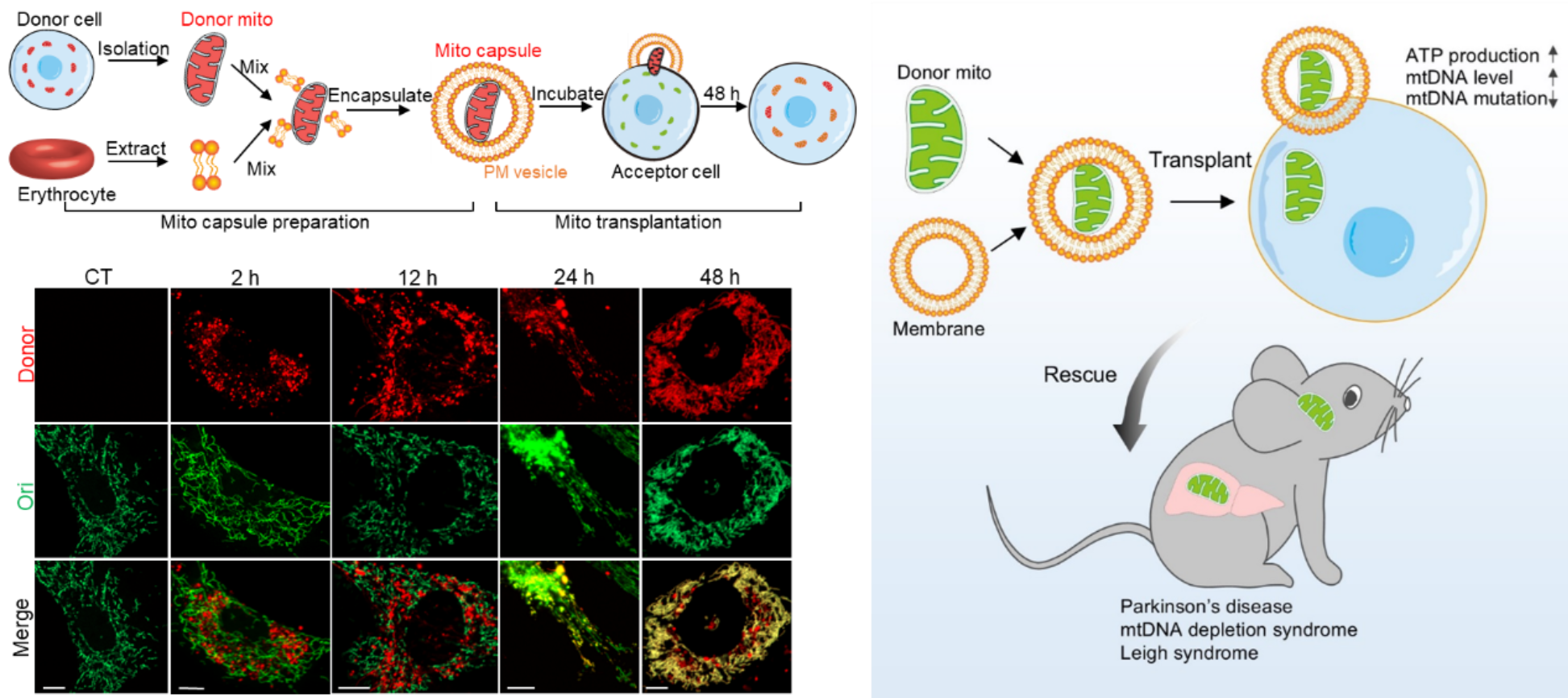
Figure 1: Schematic illustration of mitochondrial capsule assembly and transplantation
Donor mitochondria are encapsulated within erythrocyte membrane derived vesicles, forming capsules that deliver functional mitochondria into recipient cells with high efficiency, followed by fusion with the endogenous mitochondrial network.
Employing quantitative synthetic biology and regenerative medicine strategies, this work establishes a highly efficient and safe mitochondrial transplantation system. It not only deepens the fundamental understanding of mitochondrial biology and organelle based therapeutics, but also provides innovative design strategies for the coordinated modulation of functional modules in artificial synthetic life systems.
This study demonstrates the potential of mitochondrial capsules for treating mitochondrial disorders and proposes an “organelle therapy” strategy for regenerative medicine. The research not only establishes a highly efficient and safe transplantation system but also represents a landmark achievement in the emerging field of organelle therapy. In the future, it may become possible to use healthy organelles—including mitochondria—as a form of medicine, directly delivering them into patients to repair the function of diseased tissues and organs.
In the grand vision of synthesizing life from the ground up, mitochondria—as once independent endosymbionts that have co evolved within eukaryotic cells—represent a core challenge in achieving precise control over cellular energy modules. This study achieves, for the first time, the functional transplantation and integration of exogenous mitochondria in mammalian systems, not only correcting disease phenotypes but also demonstrating that we can replace and upgrade the “energy core” of cells with the same precision as assembling modular parts. A long standing hurdle in the synthetic organelle field has been the efficient delivery of functional organelles into cells; our encapsulation technology provides a universal platform for organelle delivery. Furthermore, as the construction of synthetic cells lies at the heart of synthetic life, this technology offers a ready made energy metabolism core for artificial cells, paving the way toward programmable synthetic life and establishing a foundational capability for national strategic scientific priorities. This work therefore places China at the international forefront of “organelle synthesis” and “energy module reconstruction” within the broader landscape of synthetic life research.
Cite: Du, S., Long, Q., Zhou, Y., Fu, J., Wu, H., Yang, L., Xie, Y., Ding, Y., Zhang, M., Guo, J., Wang, M., Lin, J., Hu, M., Zhang, J., Yao, D., Li, W., Bao, F., Xiang, G., Wu, Y., Huang, Y., Liang, H., Wang, R., Li, H., Chen, B., Li, C., Wang, J., Zhang, J., Qin, D., Sun, J., Zhu, Y., Sun, F., Wang, W., Lu, G., Chan, W.-Y., Zhao, H., Liu, C., Liu, X. Transplantation of encapsulated mitochondria alleviates dysfunction in mitochondrial and Parkinson's disease models. Cell 189(10):2821-2833.e23 (2026). https://doi.org/10.1016/j.cell.2026.02.023