Professor Chenli Liu and his research team from the Shenzhen Institutes of Advanced Technology, Chinese Academy of Sciences have reported a study focusing on the extrusion-modulated DnaA activity oscillations that coordinate DNA replication with biomass growth in Escherichia coli, which marks a significant step forward in advancing our understanding of bacterial cell cycle control and the coordination between DNA replication and cellular growth. The original research paper was published as a reviewed preprint in eLife on October 17, 2025.
Synthetic life from scratch—particularly coordinating and assembling diverse biological functional modules into an orderly, self-sustaining cellular system—remains one of the most formidable challenges in contemporary life sciences. Focusing on this fundamental problem, the research team led by Prof. Chenli Liu has long been dedicated to unraveling the coordination mechanisms of DNA replication, biomass growth and cell division in natural cells, guided by the synthetic biology philosophy of “building to understand and engineering to apply”.
Recently, the research team has directly demonstrated for the first time that periodic oscillations of DnaA activity function as the core signal initiating DNA replication. Furthermore, they proposed and validated a novel “extrusion” mechanism on replication initiation to coordinate DNA synthesis and biomass growth. The research was formally accepted by eLife under the title “Extrusion-modulated DnaA activity oscillations coordinate DNA replication with biomass growth.”
In the regulation of the bacterial cell cycle, the initiator protein DnaA plays a central role. The classical theory predicted that there exists a dynamic correlation between changes in DnaA activity and the initiation of DNA replication, but this correlation was never directly observed. Additionally, the classical theory suggested that DNA replication would stop once DnaA synthesis is blocked, which is inconsistent with the actual facts. These inconsistencies have inspired the research team to explore whether there are unknown regulatory mechanisms that coordinately control the operation of the bacterial cell cycle.
To directly observe the cell cycle-dependent oscillation of DnaA activity, they constructed a strain with quantifiable regulation of DnaA activity, and designed and synthesized a series of synthetic promoters responsive to DnaA activity. By systematically quantifying the response characteristics of these promoters to changes in DnaA activity, the team screened out Psyn66, a promoter highly sensitive and specifically responsive to DnaA activity. Subsequently, with the help of mRNA fluorescence in situ hybridization (FISH) technology and using the constitutive promoter Pcon, which does not respond to DnaA activity, as a reference, the team deciphered the cell cycle dynamics of DnaA activity reported by Psyn66. Quantitative analysis showed that regardless of changes in growth rate or interference with gene expression, DnaA activity exhibited significant cell cycle oscillations. These oscillations were independent of the transcription of the dnaA gene, and the peak always appeared precisely at the moment of DNA replication initiation, supporting the classical theory that "bacterial DnaA activity determines the timing of DNA replication initiation".
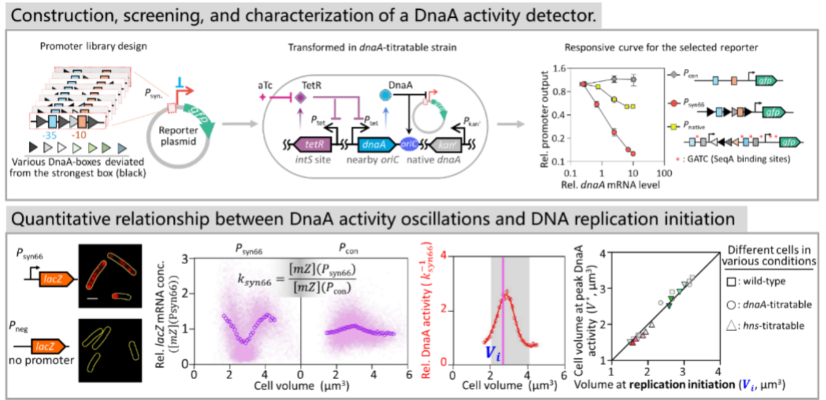
Figure 1: Development of a DnaA activity detector to quantify cell-cycle oscillations and their relationship to DNA replication initiation.
Subsequently, the team further investigated the underlying mechanism that allows multiple rounds of DNA replication to proceed even after DnaA expression is halted. Computational modeling analyses revealed that integrating an extruder-responsible for modulating DnaA activity-into the canonical framework, namely the newly established extrusion model, could perfectly elucidate this unexplained biological phenomenon. Focusing on the highly abundant DNA-binding protein H-NS, the research group further constructed tailored genetic circuits to achieve either stable or transient upregulation of H-NS expression; correspondingly, they observed continuously enhanced and rapidly boosted DnaA activity, respectively. These findings offer solid direct evidence that H-NS functions as an extruder to modulate DnaA activity, strongly validating the scientific plausibility of the extrusion model.
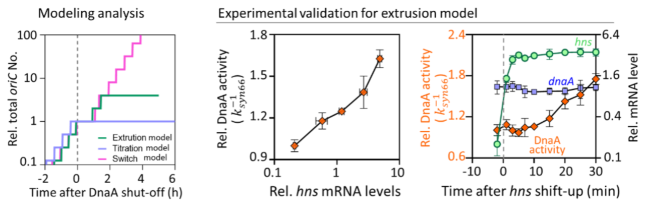
Figure 2: Mathematical modeling and experimental validation of the "extrusion model" for DnaA activity regulation.
Employing quantitative synthetic biology strategies, this work unravels a novel mechanism coordinating cellular growth and DNA synthesis. It not only deepens the fundamental understanding of bacterial cell cycle regulation, but also provides innovative design strategies for the coordinated modulation of functional modules in artificial synthetic life systems.
Cite: Li, D., Zheng, H., Bai, Y. et al. Extrusion-modulated DnaA activity oscillations coordinate DNA replication with biomass growth. eLife 14:RP107214 (2025). https://doi.org/10.7554/eLife.107214.2