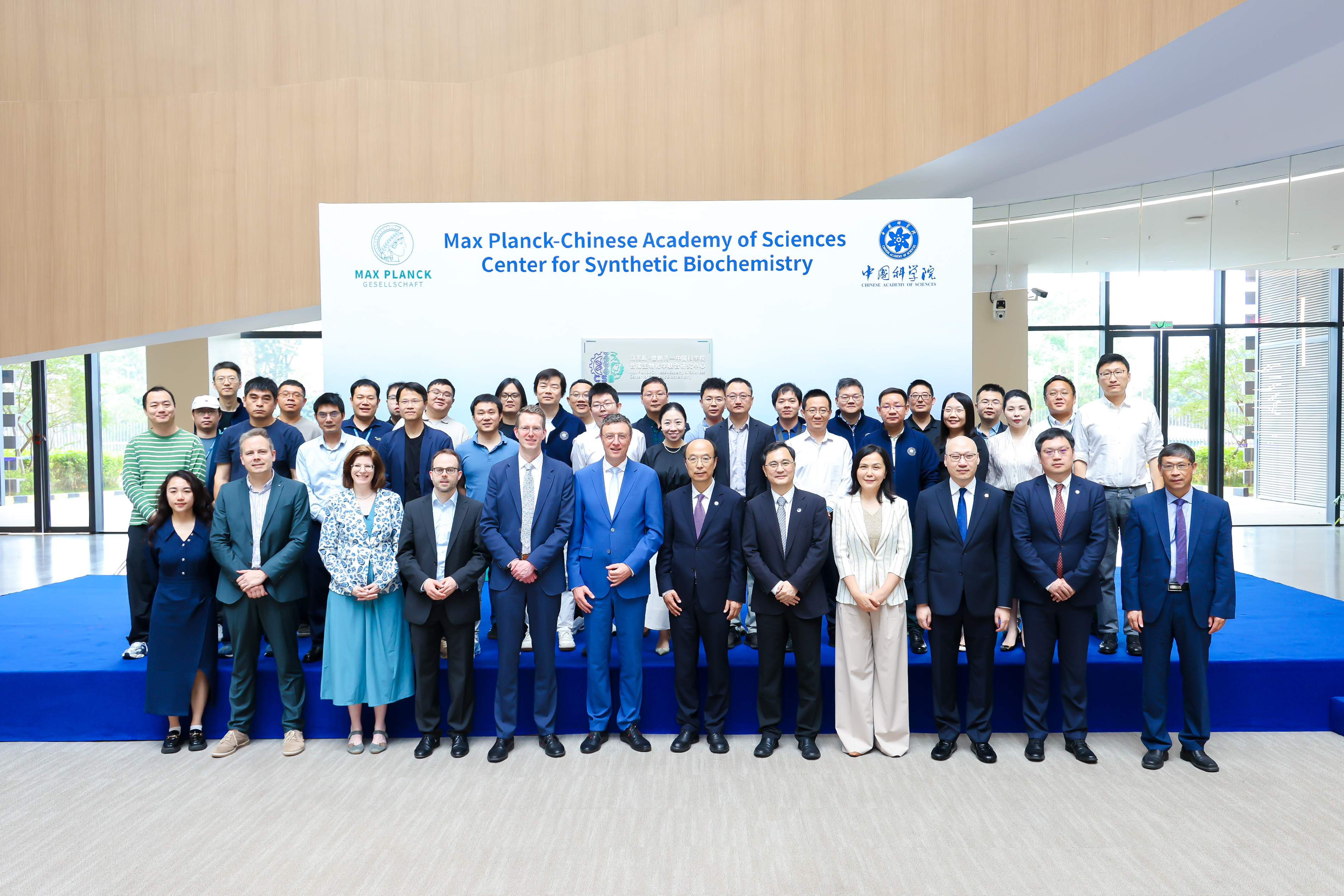
Max Planck and CAS Launch First Joint Synthetic Biology Research Center in Shenzhen
On April 18, the “Max Planck – Chinese Academy of Sciences Joint Research Center for Synthetic Biochemistry” was officially inaugurated in Shenzhen. Established by the Shenzhen Institutes of Advanced Technology (CAS) and the Max Planck Institute for Terrestrial Microbiology (MPG), the center represents the first international joint research center in synthetic biology founded by the Max Planck Society.
A 50-Year-Strong Partnership
CAS and MPG first established formal cooperative relations in 1974. After more than five decades of fruitful collaboration, the two institutions have consistently produced significant results. Building on this legacy, they signed a new cooperation agreement in Beijing on April 13 this year to jointly support the establishment of additional Max Planck International Centers.
2024 Exchanges in Berlin Paved the Way
The Joint Center builds on a solid foundation of recent bilateral exchanges. Since 2022, the two sides have engaged in multiple rounds of visits and dialogues. Notably, in 2024, they co-organized the CAS-MPG “Quantitative Synthetic Biology Symposium” in Berlin, Germany, and jointly hosted the “Quantitative Synthetic Biology Summer School” in Shenzhen. These initiatives fostered cutting-edge exchanges among young Chinese and German scholars, deepened mutual trust, and laid essential groundwork for the Joint Center’s establishment.
Complementary Strengths for Breakthroughs
Co-directed by Professor Liu Chenli (SIAT) and Professor Helge Bode (Max Planck Institute for Terrestrial Microbiology), the Joint Center focuses on major challenges such as natural product discovery and green biomanufacturing. MPG contributes expertise in fundamental biosynthesis mechanisms, metabolic design, and cell-free systems, while SIAT brings capabilities in high‑throughput automation, AI‑driven engineering, and major research infrastructure—accelerating the Design‑Build‑Test‑Learn cycle and tackling bottlenecks in biomedical natural compound libraries.
Leadership Perspectives
Professor Patrick Cramer, President of the Max Planck Society, noted that the Joint Center’s location in Shenzhen showcases the city’s open innovation ecosystem and SIAT’s strong expertise in synthetic biology. Liu Weidong, Director of the CAS Bureau of International Cooperation, emphasized that the Joint Center represents a solid step in deepening Sino-German cooperation and will provide technological support for biomanufacturing and sustainable development.
A Model for Open Innovation
The Joint Center marks a shift from project-based to institutionalized international collaboration. Supported by Shenzhen’s national pilot demonstration zone and its synthetic biology research infrastructure, the center embodies the open science principles of “co-construction, sharing, and global use.”